
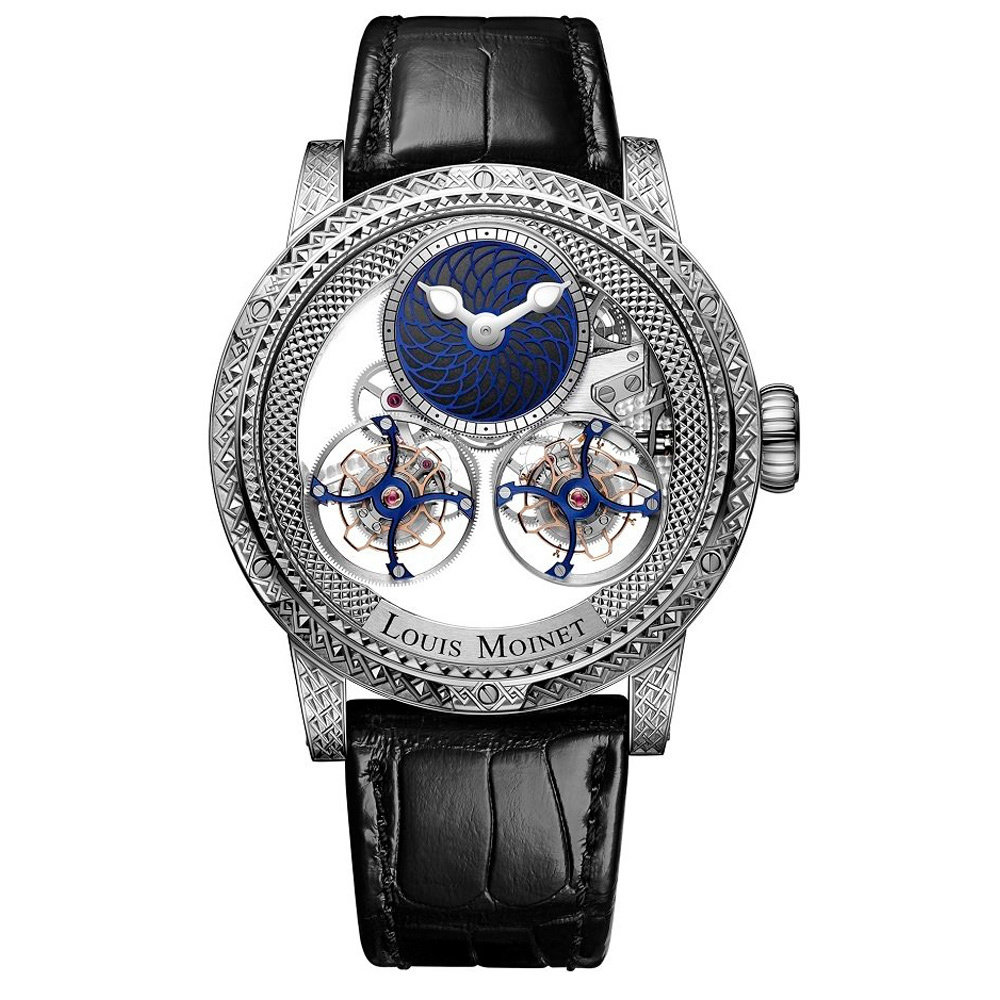
Dhofar
An interstellar inverted double tourbillon
“Dhofar is an invitation to embark on an interstellar journey through a complete skeletonized movement – a whole new kind of discovery that’s singularly technical and poetic”. The timepiece in question defies comparison, simply because to date, Dhofar does not have any equivalent anywhere in the world of watchmaking, and is protected by two patent applications
Sidereal – and staggering
Dhofar is structured around two especially extraordinary tourbillons:
- Both of these tourbillons are oversized, with cages measuring 14.9 mm – half as big again as the average. This is the largest assembly of two tourbillons
ever to have existed.
- The two tourbillons are designed to be physically above the skeletonized movement. The two raised cages are revealing balance wheels with beautifully styled screws – and an absolutely incomparable aesthetic appearance.
Tourbillons move a blue-tinted titanium disc
This exceptional timepiece is presenting an exclusive movement to Louis Moinet. Suspended in mid-air, the two tourbillon cages weigh a mere 0.4 grammes each, but nonetheless generate enough energy to power a rotating disc – made from blue-tinted titanium and featuring openwork arabesque patterns adding a further touch of mystery.
Dhofar 457
Named after the southernmost region of the Sultanate of Oman, on the border with Yemen, this lunar meteorite began its journey some three thousand years ago, when it was ejected from the Moon. After a galactic odyssey over a distance of more than 380,000 kilometres through the cosmos, it finally came to rest on the dunes in the Dhofar desert, where it was discovered by meteorite hunter Luc Labenne – his first ever moon rock find.