
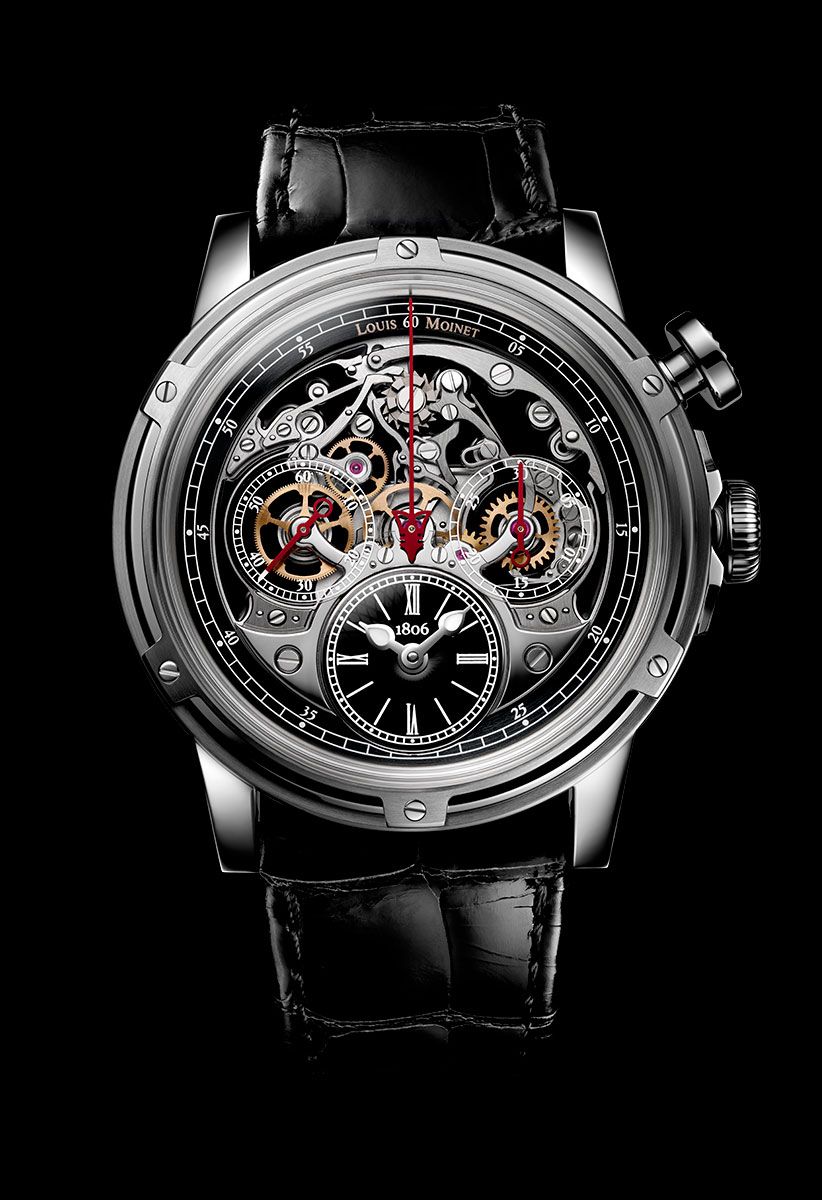
Limited to only 28 pieces
In honour of the memory of its illustrious founder Louis Moinet
unveils a visionary creation, positioning the chronograph not simply as a
complication – but as a central component of the watch.
“It’s probably the most important launch we’ve ever done.” Jean-Marie Schaller, CEO of Louis Moinet, gets straight to the point in presenting Memoris. The timepiece stands at a historic crossroads: the Ateliers’ tenth anniversary, and the bi-centenary of the chronograph invented by Louis Moinet.
As such, it was important for the creation to be markedly different from its forebear, as well as celebrate its heritage. While everything – or almost everything – chronograph-related already seems to have been invented, there was still one step nobody had dared take: no longer seeing the chronograph as a complication, but rather as the primary function of the timepiece. So much for watch chronographs; Memoris is the first chronograph-watch in watchmaking history.
The chronograph as the primary function – and time as the complication
The concept began to come into being almost three years ago now, with Louis Moinet starting again from scratch. “We couldn’t draw inspiration from what had gone before; everyone else worked from the premise that the chronograph was an additional complication on top of the time function,” explains Jean-Marie Schaller. “Our starting point was the opposite: sweeping away the past and making the chronograph the heart of our design; the central component to which we then added a time function, rather than the other way round.”
In short, Ateliers Louis Moinet did exactly what the eponymous inventor of the chronograph did in his day; taking a completely different approach to watchmaking rather than attempting merely to improve on an existing model. Indeed, that’s how Moinet invented the chronograph and was the first to achieve high frequencies – among his other remarkable lifetime achievements.
A single guiding principle: forget the past and start from scratch
The starting point may be easy to understand, but turning it into mechanical reality required a great deal of effort. Sharing its strategic thinking with Concepto, the movement manufacturer that has worked alongside the brand since its outset, Louis Moinet considered the usual set of traditional watchmaking questions, but applied them to the chronograph: what should be highlighted, what techniques should be used, and what should be shown off?
A thorough knowledge of the history of watchmaking led to the first answers. There can be no doubt that any noble chronograph must have a traditional clutch column wheel. What’s more, tradition dictates that it should feature a monopusher, the most delicate part of the exercise. And given its central role, it made sense to highlight the chronograph by having it occupy pride of place on the dial.
That left the question of what to leave visible, on display. For Louis Moinet, the answer here was quite simply everything: with Memoris, the entire chronograph function has been shifted to the dial.
As a result, the timepiece lives up to every possible expectation. Each aspect of the chronograph’s action can be admired in its entirety, as soon as the pusher is pressed. The column wheel orchestrates the graceful ballet of the mechanism of steel and gears, passing information to the hands. The chronograph reigns in splendid isolation on the dial, leaving the beholder in no doubt that it is neither a skeleton nor an additional component: the all-new movement has been designed for the chronograph alone, and places it centre stage. Louis Moinet has opted to place the traditional workings of the automatic mechanism on the back of the movement, beneath the plate.
A wholly new approach to the casing
To showcase the chronograph in the style it deserves, Louis Moinet has redeveloped practically every decorative item, with a new case, new hands, a new dial, a new oscillating weight, a new folding clasp, and more.
As a bonus, Louis Moinet has come up with a wholly exclusive use of synthetic gemstones. Usually destined to serve as good pivots and provide proper lubrication of the movement components, gemstones have now found a new purpose elsewhere. Black zircon, in a screwed setting, has been used decoratively – on the case horns.
Embodying the essence of true commemoration – all the life of the present, rooted in history – it links Louis Moinet’s heritage with the creative vision of the Ateliers that today honour his memory.
The originality of the MEMORIS SUPERLIGHT resides in the separation of the chronograph (with its 147 components) from the automatic mechanism (164 components). The entire chronograph has been positioned at the top of the watch, with the automatic part located beneath the plate.
MEMORIS SUPERLIGHT is a visual delight, too. With a single gentle touch on the monopusher, a unique performance unfolds before your eyes. All of the components of the chronograph - yokes, clutch, hammers, column wheel, springs and wheels - are set in motion, responding to each other as they
serve their ultimate purpose: measuring a specific time.
The case, fashioned in grade 5 titanium, has a polished, satin-effect finish. Non-corrosive titanium allows for the manufacture of slim, lightweight components; here, the case weighs less than 31 grammes, making it especially comfortable on the wrist.